planner
Read-only planning; returns questions, writes nothing.
read-onlyOpen source (MIT) · v0.10.1 · public beta
Otter Swarm turns Devin CLI and Devin Desktop into a team. A planner, researcher, implementer, reviewer, tester and interrogator — each pinned to the exact model you choose, each returning evidence, every run leaving a durable record.
 Built for Devin CLI and Devin Desktop
npm test)
Measured on the Standard preset; free-tier pricing is promo-dependent.
01 / How it works
/model picks the lead. It talks to you, asks the questions, and runs all web tooling.
~/.config/devin/agents/<role>.md holds an exact uid plus a fallback chain, verified against your account's model list. Pins survive sessions — and are checked at dispatch: a profile whose model: disagrees with the recorded pin is refused before the worker spawns, not silently substituted.
Owns: paths, Touched / Ran / Next footers, P0–P3 findings with evidence, PASS / FAIL / INCONCLUSIVE gates. A missing lane never approves.
Run manifests in .devin/otter/runs/, attest blocks on the plan, and /otter:stats record what actually happened.
Briefs go out. Evidence comes back: Touched / Ran / Next.
02 / Roles
Read-only planning; returns questions, writes nothing.
read-onlyRepo and source-pack analysis; read-only map.
read-onlyOne exact Owns:-bounded write slice, test-first.
Clean-context P0–P3 critique of a diff or plan.
read-onlyRuns the relevant tests; high-assurance acceptance matrices.
execOpt-in adversarial verification of a change or plan.
read-only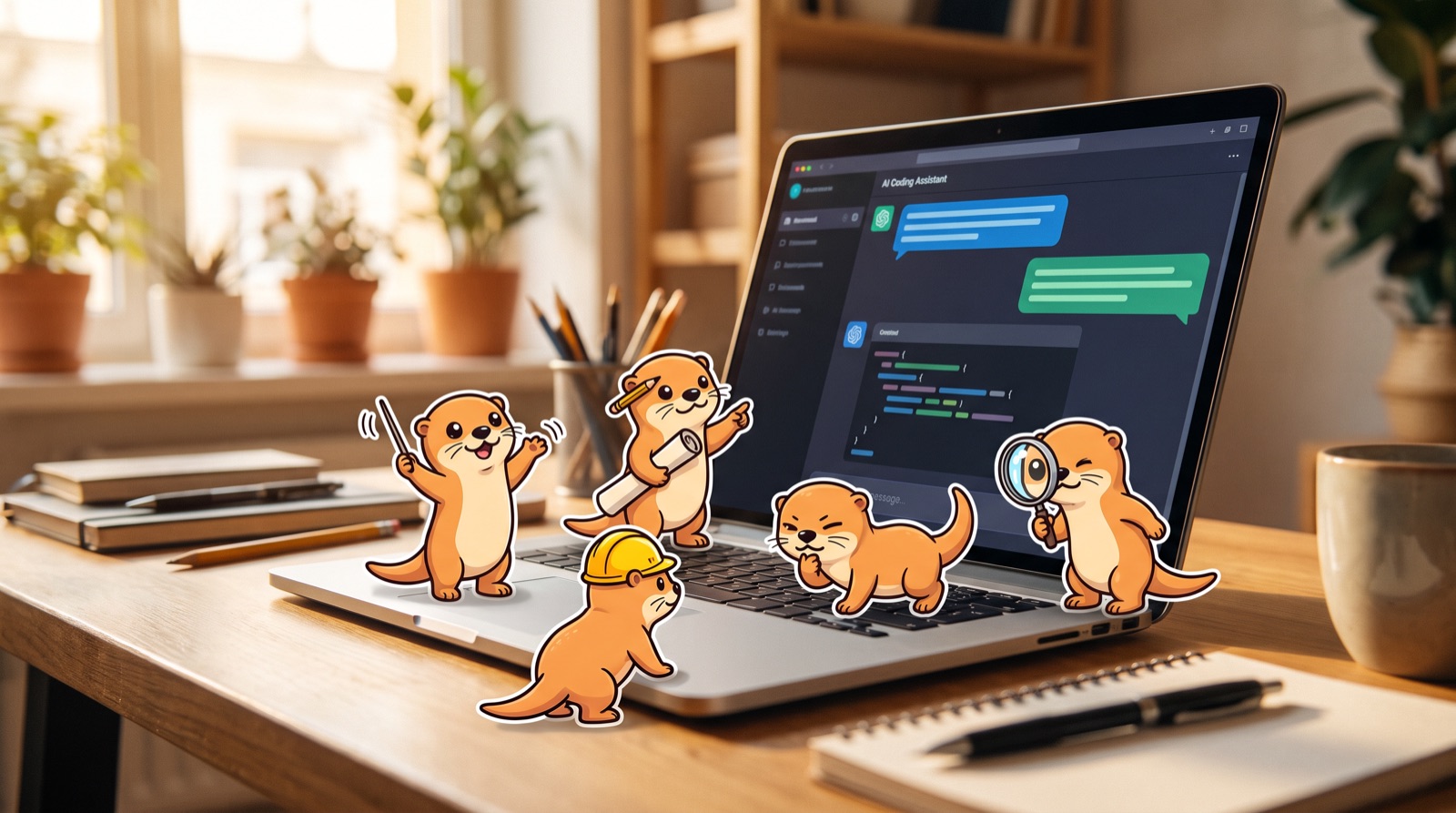
The swarm: planner, researcher, implementer, reviewer, tester, interrogator.
03 / Pins
A pin is an exact uid written to ~/.config/devin/agents/<role>.md and verified against devin models list. No per-session overrides, no invented ids.
~/.config/devin/agents/<role>.md./otter:setup always asks: Standard / Budget / Max / pick each role.devin models list./otter:models reviewer grok-4-6-high changes exactly one file.model: line — your hand-edited prompt body survives./otter:models off / on park and restore the whole panel./otter:models show current pins
/otter:models standard|budget|max
/otter:models reviewer grok-4-6-high
/otter:models repair
/otter:models off · onStandard's reviewer shares a family with the implementer. For a cross-family opinion pin a different reviewer or run /otter:review dual. At standard assurance the lead itself reviews; review=worker brings the pinned reviewer back.
04 / Pipeline
/otter:orchestrate — evidence in, verdict outThe lead sizes the work, asks, then runs bounded lanes. Every lane leaves a receipt — and the plan gate applies at every assurance level: you approve the plan before any writer starts.
Classify the task, ask 1–3 questions, require exact Owns: paths before anything spawns. You see the whole plan and approve, revise, or abort before any writer starts.
One researcher by default; fan-out of 2–3 only for independent questions. The lead builds source packs.
researcherOne writer per tree, Owns:-bounded, test-first. Independent slices run in parallel worktrees — the plan itself says which: each slice declares Covers: (the criteria it satisfies) and Depends on:. Edits outside Owns are flagged and reviewed by the lead, not bounced to you.
The lead re-runs the green test command; a tester matrix runs on high or when evidence is missing.
testerThe lead reviews the diff under the reviewer contract — P0–P3 findings, each backed by a probe, validated by script. On high assurance or review=worker a clean-context reviewer runs instead. An open P0 or P1 is a FAIL.
Only request_changes, a failed test lane or an open P0/P1 starts a repair round; an approve with P2/P3 findings ends the run and lists them as follow-ups. One sequential implementer repairs; the loop never runs blind.
implementerGit diff, exit codes, artifacts. Worker summaries are not proof. The acceptance criteria the evidence covers get ticked in the plan; the reply shows AC → evidence.
leadTimestamp, panel-observed profile names and requested pins written to the run and the plan.
leadSlices with disjoint Owns: fan out automatically into linked worktrees — up to four writers at once, never two on one tree. Binary patches are applied back to main sequentially and hash-checked, then tested and reviewed once on the integrated tree. worktrees=1 forces sequential.
On a 5-module task the pipeline ran 6× the wall time and 2.9× the cost of a stock lead — down from 20× and 6.6× three days earlier, after fixing our own tooling friction, moving state writes to one checkpoint per phase, and letting the lead review at standard assurance. Single-worker skills like /otter:implement passed every gate at $0 on the free SWE-2 pin.
| bench (2026-09-13) | pass | cost |
|---|---|---|
| implement · 1 file | 5/5 | $0 vs $0.06 |
| implement · 5-module | 5/5 | $0 vs $0.19 |
| orchestrate · 5-module | 5/5 | 2.9× ($0.59) |
| review · planted off-by-one | 5/5 | 2.4× |
| review · 3 planted bugs | 5/5 caught (stock too) | 1.3× |
| review dual · 3 planted bugs | 5/5 caught (stock too) | 4.5× |
| research · repo question | 5/5 | 1.2× |
Honest note: on a standalone diff a strong lead found the same three bugs in 30 s. The reviewer's value is independence inside orchestrate and the validated contract, not raw detection; dual is for high assurance.
05 / Research
/otter:researchOne researcher. Classifies the question repo / web / mixed. For web, the lead fetches up to 8 sources into a source pack — subagents have no web tools.
/otter:research … wideUp to 3 parallel researchers on cleanly decomposable questions. Disagreements are kept, not averaged. output=<path> writes cited markdown.
/otter:deep-research experimentalPlan → Research (≤4 researchers, lead-fed source packs) → Verify (2 reviewer shards, independent corroboration from a second source) → Report. Cited markdown; status Verified / Source-checked / Partial. Budget N+2 calls nominal, 2N+4 worst.
06 / Reports
.devin/otter/runs/<run-id>.json — workers, requested pins, phases, lanes, budgets, outcome.
Appended to the plan file: timestamp, panel-observed profile names, run-time pins.
/otter:stats report week writes reports/otter-usage-<scope>.html — a self-contained dashboard: the data travels inside the file, so period, project, agent and model filters, the timeline and per-session drill-down all run in the browser, zero network requests. Cost from a live price snapshot, --redact for sharing, stats serve runs it live.
/otter:gate aggregates lanes into PASS / FAIL / INCONCLUSIVE. A missing lane never approves.
Cited markdown with [S1]…[Sn] markers and honest coverage notes.
node scripts/e2e.mjs --report and --bench keep the whole suite honest.
otter-telemetry MCP serverThe same data as in-session tools, answerable from any session — even ones that never invoke an otter skill.
Attribution is structural: each turn is filed under the agent whose system prompt roots its subtree, so every turn lands in exactly one bucket — nothing sits in "unattributed".
07 / Command reference
Everyday chat is normal Devin on your picker model. Otter Swarm only runs when you call an /otter: command.
/otter:review (add dual for reviewer + interrogator)/otter:orchestrate <task>/plan, leave plan mode, then /otter:orchestrate/otter:research <question> (wide for parallel)/otter:deep-research <query> (experimental)/otter:diagnose <symptom>/otter:hyperplan <plan> or /otter:plan review/otter:gate plan=<path>/otter:goal set <objective>/otter:stats — or just ask "what did I burn today?"/otter:stats report weekSet up
Once per machine. Pins live on disk and survive sessions.
/otter:setup
lead only
What it doesWrites the six worker profiles and the pin sidecar. Always asks how you want worker models: Standard, Budget, Max, or pick each role.
When to useFirst run. After an update, run /otter:doctor instead.
/otter:setup
/otter:models …
lead only
What it doesShow or change worker pins: a whole preset, one role at a time, repair to re-verify against your account, off / on to park or restore all profiles.
When to useYou want a different model for one role, or a worker failed to spawn.
/otter:models reviewer grok-4-6-high
/otter:doctor [verbose|json|live]
lead only
What it doesStatic checks of the installation, profiles, pins, state, and known platform limits. A paid dispatch smoke test only runs with your explicit confirmation.
When to useSomething stopped working, especially after devin plugins update.
/otter:doctor verbose
/otter:beta-report
lead only
What it doesPacks a redacted diagnostics bundle — doctor output, the usage cube, run manifests, price-snapshot status — into .devin/otter/beta/ plus a .tgz. Nothing is uploaded; you attach the archive to an issue yourself.
When to useReporting a bug during the beta — the bundle shows what ran without sharing your code or prompts.
/otter:beta-report
Build
One writer per tree. Every slice declares the files it may touch; disjoint slices run in parallel.
/otter:plan <objective>
workers: planner
What it doesThe read-only planner drafts a canonical plan and returns owner questions. You answer, the lead validates and writes the approved plan.
When to useYou want scope settled before anything is built.
/otter:plan add rate limiting to the API gateway
/otter:orchestrate <task> [assurance=light|standard|high] [review=lead|worker] [worktrees=1|N] [plan=<path>]
workers: implementer · researcher, tester, reviewer by assurance
What it doesSizes and clarifies the work, then runs research when needed, implementers on Owns:-bounded slices (disjoint slices fan out to parallel worktrees), the lead's own test re-run and review at standard assurance (tester matrix and reviewer worker on high), with durable run state written once per phase.
When to useA feature built with verification.
/otter:orchestrate add rate limiting to the API gateway assurance=high
/otter:implement …
workers: implementer
What it doesOne implementer on one exact Owns:-bounded slice, test-first. A slice that needs an unowned file edits it minimally and flags it; the lead reviews the whole diff.
When to useYou know exactly which files change and want a cheap pinned writer.
/otter:implement Owns: src/limiter.mjs tests/limiter.test.mjs — add a token bucket
/otter:diagnose <symptom>
workers: implementer, tester
What it doesRed loop first: falsifiable hypotheses, one-variable probes, a regression that goes red then green, the fix, and every debug marker removed.
When to useA bug you want found and fixed properly.
/otter:diagnose tests fail after the migration refactor
Verify
Clean-context critics. Findings come with evidence, never fixes you did not approve.
/otter:review [dual]
workers: reviewer (+ interrogator)
What it doesA reviewer that has not seen your reasoning returns P0–P3 findings with evidence and a verdict. dual adds the interrogator in parallel and merges a triaged shortlist.
When to useA second opinion on a diff — especially one the lead itself wrote. Measured: on a foreign diff a strong lead finds the same bugs; the worker buys a clean context and a validated contract.
/otter:review dual
/otter:test
workers: tester
What it doesRuns the relevant tests, or a high-assurance acceptance matrix with criterion, command, expected and observed per row.
When to useYou need test evidence, not a summary.
/otter:test
/otter:interrogate
workers: interrogator
What it doesStandalone adversarial verification of a change or plan: assume it is wrong and try to prove it. Opt-in; not part of the default pipeline.
When to useHigh-stakes changes.
/otter:interrogate
/otter:hyperplan <plan|diff>
workers: interrogator ×2–4
What it doesTwo to four orthogonal interrogator critics on one plan or diff. The synthesis dedupes, ranks severity, and preserves contradictions.
When to useA plan stress-tested before building.
/otter:hyperplan plans/rate-limit.md
/otter:gate plan=<path>
workers: tester, reviewer
What it doesAggregates acceptance, test and review lanes into exactly one verdict: PASS, FAIL or INCONCLUSIVE. A missing lane never approves.
When to useProof a change meets its acceptance criteria.
/otter:gate plan=plans/rate-limit.md
Research
Read-only. Web sources are fetched by the lead; workers analyze.
/otter:research <question> [wide] [output=<path>]
workers: researcher (×3 with wide)
What it doesA read-only researcher answers repo questions directly; for web questions the lead fetches up to 8 sources into a source pack first. wide fans out up to 3 researchers and keeps disagreements.
When to useResearch on the repo.
/otter:research where is auth token refresh handled?
/otter:deep-research <query> [breadth=N] [output=<path>] [verify=quick]
workers: researcher ×≤4, reviewer ×2
What it doesPlan, then up to 4 researchers, then 2 verifier shards with independent corroboration, then a cited markdown report marked Verified, Source-checked or Partial. Experimental.
When to useResearch on the web, with citations.
/otter:deep-research compare rate-limiter libraries for Node
Track
Every run is durable and local.
/otter:status [json]
lead only
What it doesBounded local run and goal status: phase, workers, requested pins, budgets, blockers, next action.
When to useYou want to know where a run stands.
/otter:status
/otter:resume <run-id>
lead only
What it doesResumes the first safe incomplete phase of an interrupted run. Completed or unknown writes are never repeated automatically.
When to useA session was interrupted mid-run.
/otter:resume run-20260912-4f1c9a2b7e0d
/otter:goal …
lead only
What it doesOne persistent project objective: approved plan, linked runs, call and round budgets, pause and resume, evidence-gated completion.
When to useWork that has to survive session interruptions.
/otter:goal set ship v2 of the parser
/otter:stats [session <id>] [week|month|since <Nd>] [report]
lead only
What it doesWhat a session or period burned, per agent and per model — every turn attributed by conversation tree. report writes a self-contained dashboard under reports/; serve runs it live.
When to useYou want to know what a session cost.
/otter:stats report week
08 / Safety
The lead walks in. Then the swarm.
Independent slices run in parallel, one implementer per linked worktree, hash-checked patches, one verification on main. Never two writers on one tree.
A slice needing an unowned file edits it and flags it under Outside Owns; parallel worktree mode still stops instead.
An optional PreToolUse hook offered at setup blocks rm aimed at ~ or /, force-push, keychain access and pipe-to-shell — even inside chained commands. Fails closed while ~/.config/devin/otter-guard exists.
The sessions database is opened read-only. Nothing is uploaded.
No id in the chain resolves on your account → nothing is written, and the error names the role. Drift later? The dispatch check refuses the spawn and names /otter:models repair.
09 / Get ready
devin plugins --help)mkdir -p ~/.config/devin/agents
cp templates/agents/*.md ~/.config/devin/agents/devin plugins install chris-wozniczek/otter-swarm # public — plugin beta access required
/otter:setup # pick a preset, opt into the guard + update check
devin plugins update otter # later: pull a release, then start a new session and run /otter:doctordevin plugins update otter pulls a release, then start a new session — skill bodies load at session start — and run /otter:doctor. Pins, profile bodies and run state live outside the plugin root and are never touched. The opt-in session-start check tells you once per new version: one GET of plugin.json, nothing sent — touch ~/.config/devin/otter-no-update-check to stop.
MIT-licensed, public on GitHub — issues, the beta-report template, ATTRIBUTIONS.md, and the full test log live in the repository.